
The meaning of “giclée”
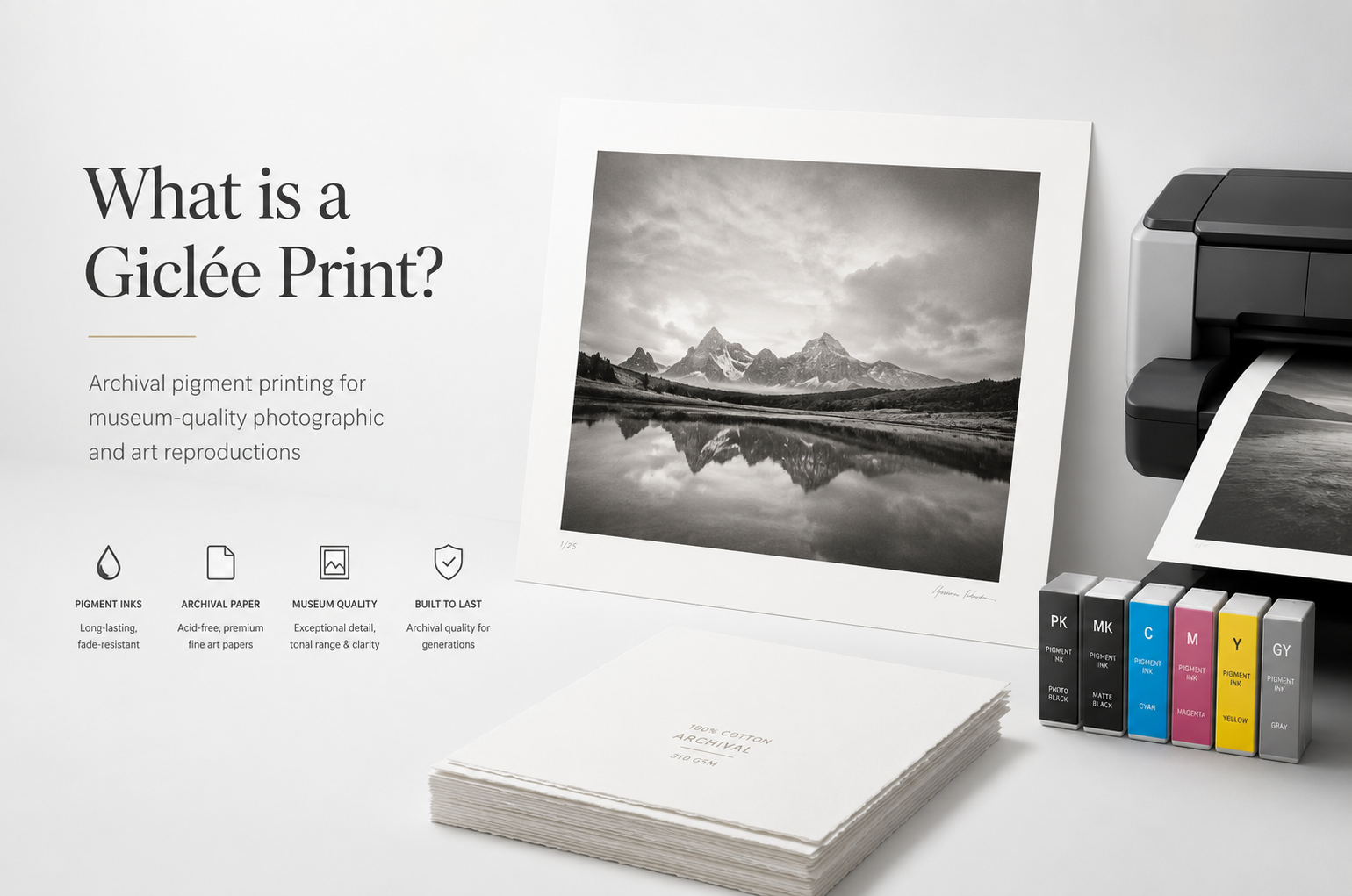
The word “giclée” comes from the French verb meaning “to spray” or “to project.” In fine art printing, it refers to the precise spraying of microscopic ink droplets onto paper or canvas. Unlike standard poster printing, a giclée print is produced with careful control over resolution, color, tonal range, paper texture, and final presentation.
For photographers and artists, this matters because a great image is not only about sharpness. It is also about subtle shadows, smooth gradients, deep blacks, delicate highlights, and the tactile feeling of the paper itself.
Why giclée printing is used for fine art
Exceptional detail
Giclée printing can reproduce very fine image detail, making it ideal for photography, landscape work, portraiture, black-and-white images, and limited edition art prints.
Beautiful tonal range
The process is valued for smooth transitions, rich shadows, controlled highlights, and a refined tonal depth that gives the print a gallery-level presence.
Archival intention
When paired with quality pigment inks and acid-free fine art papers, giclée prints are designed for long-term display, collection, and preservation.
The giclée printing process
File evaluation
The image is checked for resolution, sharpness, color profile, noise, crop ratio, and print size suitability before production begins.
Color preparation
The file is prepared for print so that the final result preserves the mood, contrast, and artistic intention of the original image.
Paper selection
The right paper is chosen according to the image: matte cotton for softness, baryta for depth and contrast, or textured papers for a more painterly character.
Precision printing
The print is produced on a professional fine art printer using pigment inks, controlled settings, and paper-specific profiles.
Quality control
Each print is inspected for color, density, surface quality, borders, and overall presentation before finishing or delivery.
Finishing
The print can be trimmed, signed, numbered, framed, mounted, or prepared for exhibition and interior installation.
A giclée print is not just a reproduction. At its best, it is a carefully crafted object that carries the emotion, atmosphere, and intention of the original work.
Common papers used for giclée prints
Cotton matte paper
A soft, elegant paper with a non-reflective surface. It is excellent for black-and-white photography, portraiture, landscape images, and artworks that need a quiet, museum-like feel.
Baryta paper
A premium paper with deeper blacks, stronger contrast, and a subtle sheen. It is often chosen for photographs that need richness, clarity, and visual depth.
Textured fine art paper
A paper with visible surface character. It gives artworks a more tactile, painterly, and handcrafted appearance.
Smooth archival paper
A clean and refined surface suitable for highly detailed photographs, minimalist works, and contemporary interior art.
Giclée print vs. normal photo print
A standard photo print is often made for everyday display, speed, and affordability. A giclée print is made for artistic presentation. The difference is visible in the paper, color depth, surface texture, tonal control, and the overall feeling of the print in a physical space.
- Giclée prints are typically made with archival pigment inks and fine art papers.
- Standard photo prints are often made on commercial photographic or lab papers.
- Giclée printing gives artists and photographers more control over paper character and final presentation.
- Fine art papers can change the emotional tone of an image, not only its appearance.
Who should choose giclée printing?
Giclée printing is ideal for photographers, artists, galleries, collectors, interior designers, hotels, restaurants, and anyone who wants an image to become a finished artwork rather than a simple print.
It is especially suitable for limited editions, exhibition prints, collectible photography, black-and-white work, large wall art, and carefully curated interior projects.
How to prepare your file for giclée printing
- Send the highest quality file available, preferably TIFF or maximum-quality JPEG.
- Avoid sending compressed images through messaging apps if quality matters.
- Keep the original color file when possible, instead of over-editing for screen brightness.
- Decide the final print size early so the file can be checked properly.
- Ask for a proof print if the work is for exhibition, sale, or a limited edition.
Print your work with Lumière Fine Art Printing
Lumière Fine Art Printing was created by photographers and artists for those who care about exhibition-standard image making. We help you choose the right paper, prepare your file, control color, and turn your photograph or artwork into a refined physical print.