
Questions before you print
Fine Art Printing FAQs
Use these answers to plan a project. For an unusual file, valuable original or demanding edition, describe the work to the studio so the specification can be confirmed.
Printing and materials
What does giclée mean at Lumière Print?
It describes fine art inkjet reproduction using pigment inks, suitable media and colour management. It is not a standalone certification or lifespan guarantee. The studio uses an Epson SC-P9530 with UltraChrome PRO12 pigment inks. What is a giclée print?
Which paper gives the most accurate result?
No one paper is right for every image. Its white point, texture and finish change the appearance of colour and detail. Compare materials against the image and intended display rather than selecting by weight alone.
Does a textured paper reduce detail?
Texture can make very fine lines and small details less visually distinct at close range, while giving the print more physical character. The effect depends on the image and viewing distance.
What is the difference between the two canvases?
Photo Canvas 320 is bright white with a finer weave; Canvas Artist 340 is natural white with a coarser texture. Both are poly-cotton matt canvases. Compare canvases
Files and sizing
What file should I send?
Send the best available full-resolution master with an embedded RGB colour profile. High-quality JPEG or TIFF are practical starting points. Ask before sending layered or unusual formats. Do not rely on a social-media export for a large print.
How many pixels do I need?
Calculate pixels from the printed image dimensions, not the paper sheet. Around 300 ppi is a useful close-viewing target; around 150 ppi may be a review point for large work viewed farther away. Pixel table
Will my image be cropped?
Only if the requested image ratio differs from the file and you choose to fill that format. For example, 30 × 45 cm is 2:3, while 50 × 70 cm is 5:7. Agree the crop before printing.
Is a white border included?
No standard border inclusion or price is confirmed. Specify the desired printed image and outer sheet dimensions so it can be quoted correctly.
Colour and display
Will the print match my screen exactly?
A screen emits light; paper reflects it. Screen brightness, calibration, viewing light and paper white affect the comparison. Colour management reduces avoidable variation but does not make the two media identical.
Can I soft proof?
Soft proofing requires a profile for the exact printer, ink and paper condition. Manufacturer profiles can help exploration, but ask Lumière Print which profile and settings apply to your order. Soft proofing guide
How long will the print last?
Longevity depends on the specific ink and medium, display light, humidity, pollutants, handling and frame protection more than on any single number. How to care for prints
Orders and presentation
Can I order a limited edition?
Yes. Decide the edition limit, print size, medium and finishing specification; the artist handles the promises, numbering and signature to buyers.
Do you frame prints?
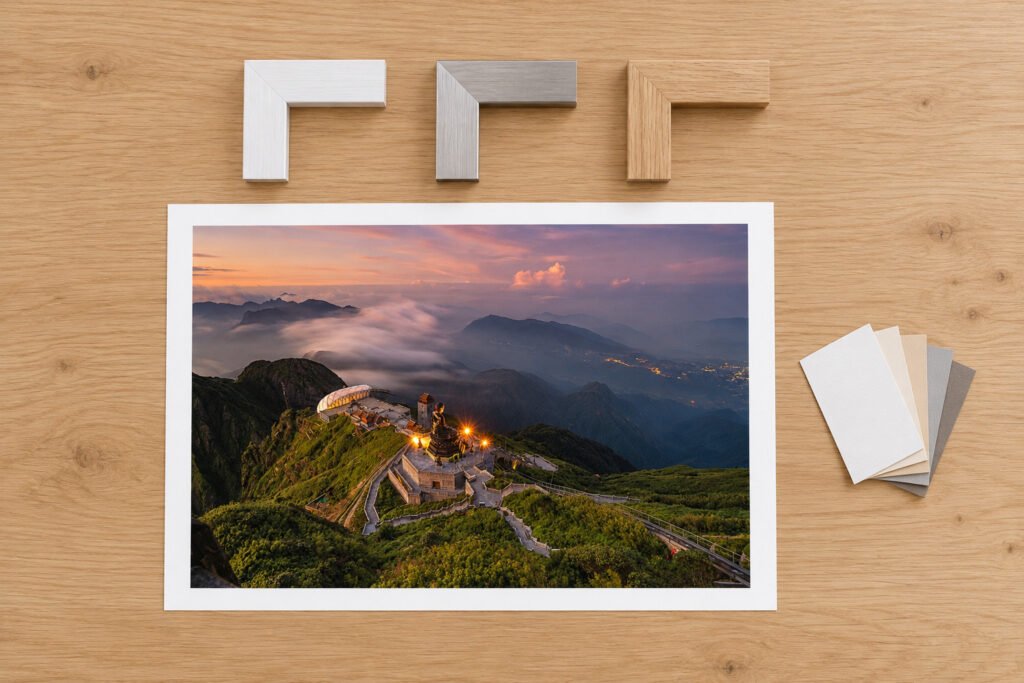
Yes: painted oak, silver aluminium and 3D oak. Confirm glazing, backing, frame colour and outer size for your project. Framing
Can you print for a luxury apartment or interior project?
Yes, a commissioned print can be planned around scale, materials and room context. Installation and special mounting are not assumed; discuss requirements with the studio.
Where can I see prices?
The price guide lists selected paper, canvas and frame dimensions in VND. Other sizes and materials need an individual quote. Prices
Start a print
Didn't find your question?
Describe the work and where it will be shown — we will answer for your file and room.